



The Chamba Chappal: A Royal Craft Born in 1808 That Still Walks
How one princess's dissatisfaction created Himachal Pradesh's most celebrated GI-tagged heritage footwear — and why it matters in 2026
The Chamba Chappal: A Royal Craft Born in 1808 That Still Walks
In 1808, a princess arrived at the Chamba royal court deeply unhappy.
Not with the match — Raja Charhat Singh of Chamba was a fine king. What troubled her was simpler, and more immediate: the shoes.
The Katoch princess, daughter of the ruling family of Kangra, had grown up in a court that paid careful attention to such things. The footwear she found in Chamba was rough, unadorned - nothing like what she had known. So she did something practical and, as it turns out, historically significant: as part of her royal dowry, she brought from the village of Panj Baria in Nurpur a master cobbler who knew how to make leather sing.
That cobbler did not just make better shoes. He started a craft tradition that, two hundred years later, carries a Geographical Indication tag from the Government of India - a legal protection that only a handful of Indian crafts have earned.
The Chamba Chappal was born from an act of aesthetic dissatisfaction. And it has been made the same way - thread by thread, sequin by sequin - ever since.
What Is a Chamba Chappal?
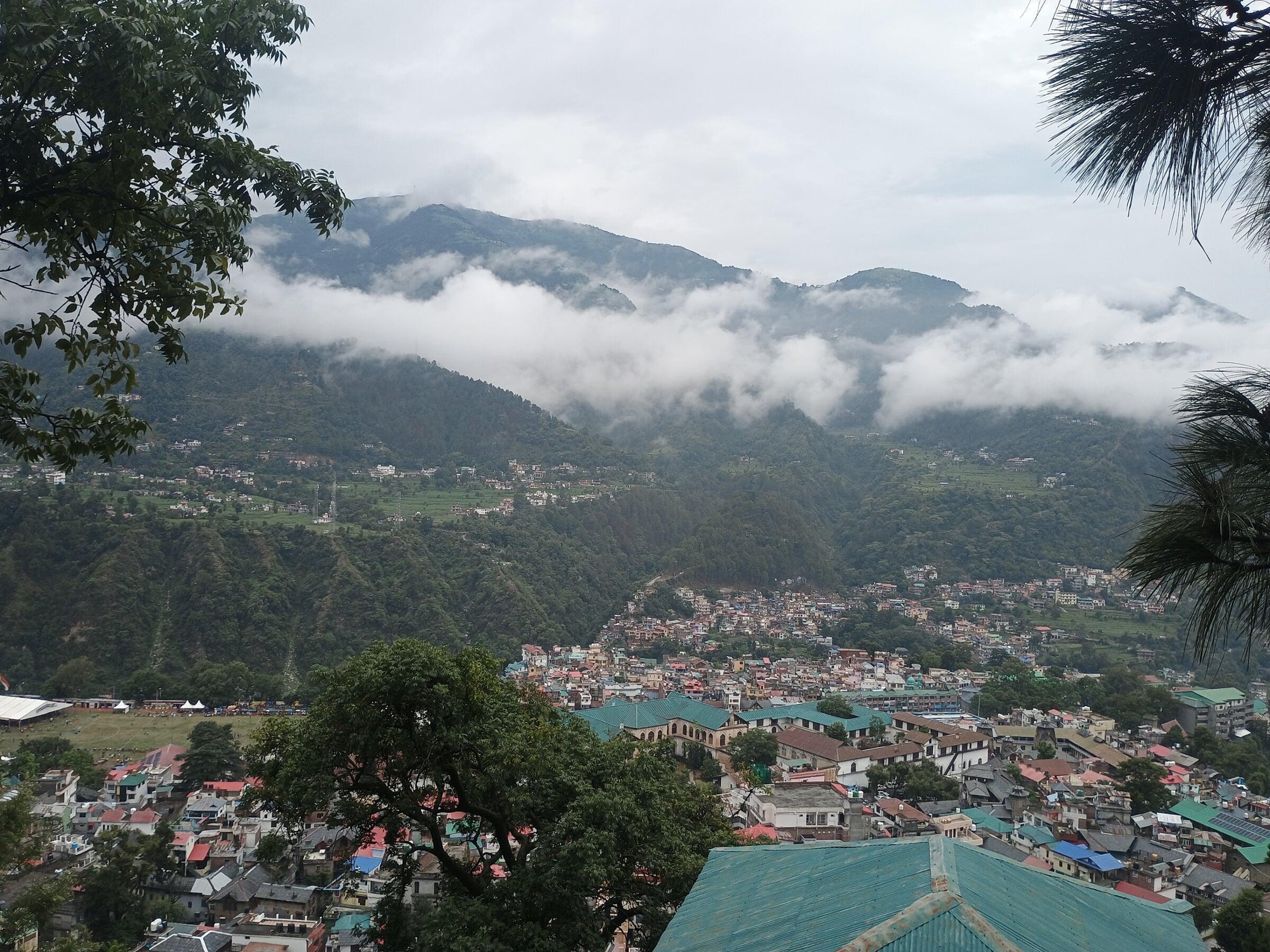
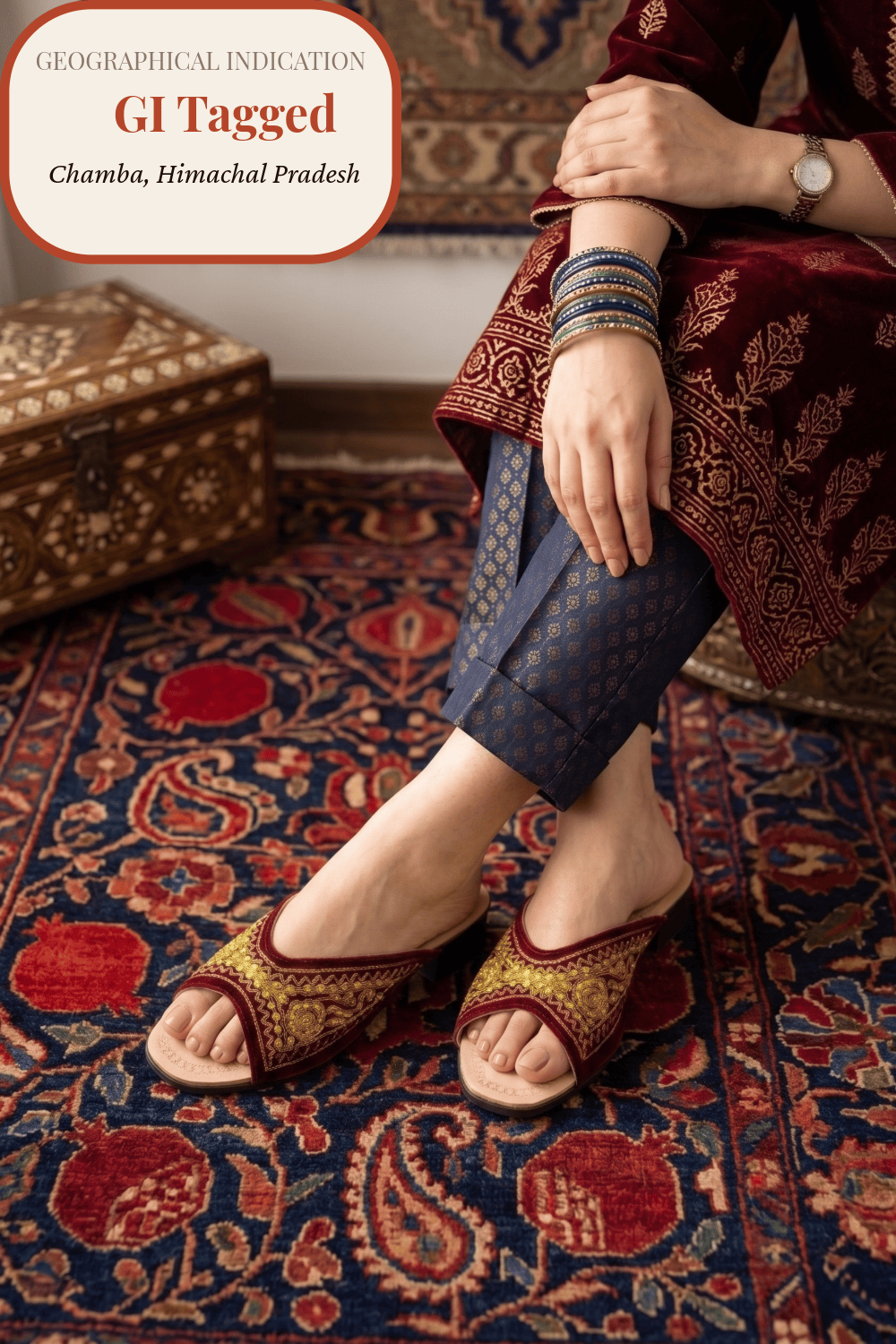
The Chamba Chappal is a handcrafted open-toe mule - an embroidered slip-on sandal - from the Chamba district of Himachal Pradesh in the western Himalayas. It is distinguished by two things that no imitation can replicate: its embroidery, and its GI tag.
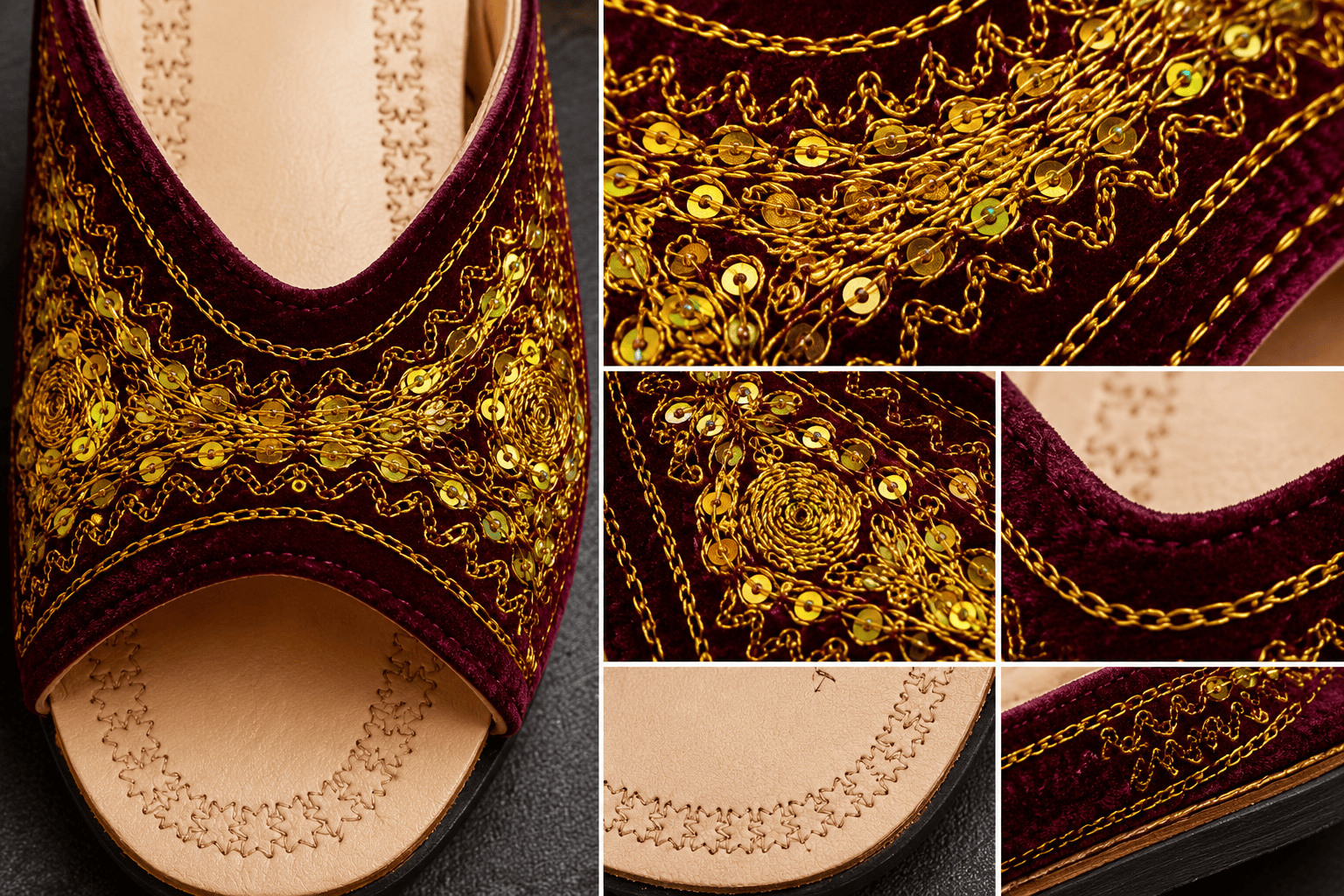
The upper of the Chamba Chappal is made from velvet — most traditionally in deep jewel tones: the particular maroon of Himalayan festivals, royal blue, dark forest green. On this velvet, artisans work two embroidery techniques in combination. The first is Tilla work: fine metallic thread, historically gold or silver, coiled and couched by hand into flowing botanical motifs. The second is Sitara work: tiny metallic sequins set individually into the velvet, each one a small, precise point of light.
The sole is leather, hand-stitched with the traditional Chamba border pattern. In the finest pairs, the heel is cut from solid wood and dressed in the same velvet as the upper - a seamless design that speaks to the craft's courtly origins. The insole and lining are leather throughout.
The result is footwear that is, without exaggeration, closer to jewellery than to utility.
The Craft — Russi-Tilla, Sitara Work, and the Chamba Kadhai Tradition
Internationally, the metallic thread embroidery on a Chamba Chappal is called Tilla work. But in Chamba, artisans have their own name for it: russi-tilla.
The name refers to the thread itself — fine metallic wire, originally silver, that was once traded along Himalayan routes from Persia and Central Asia. The technique involves coiling and couching this wire by hand onto the velvet surface, building up each embroidery motif line by careful line. Done well, russi-tilla has a dimensionality that printed or woven patterns cannot replicate. The thread sits fractionally above the velvet surface, catching directional light differently at every angle. You see different things in it morning and evening.
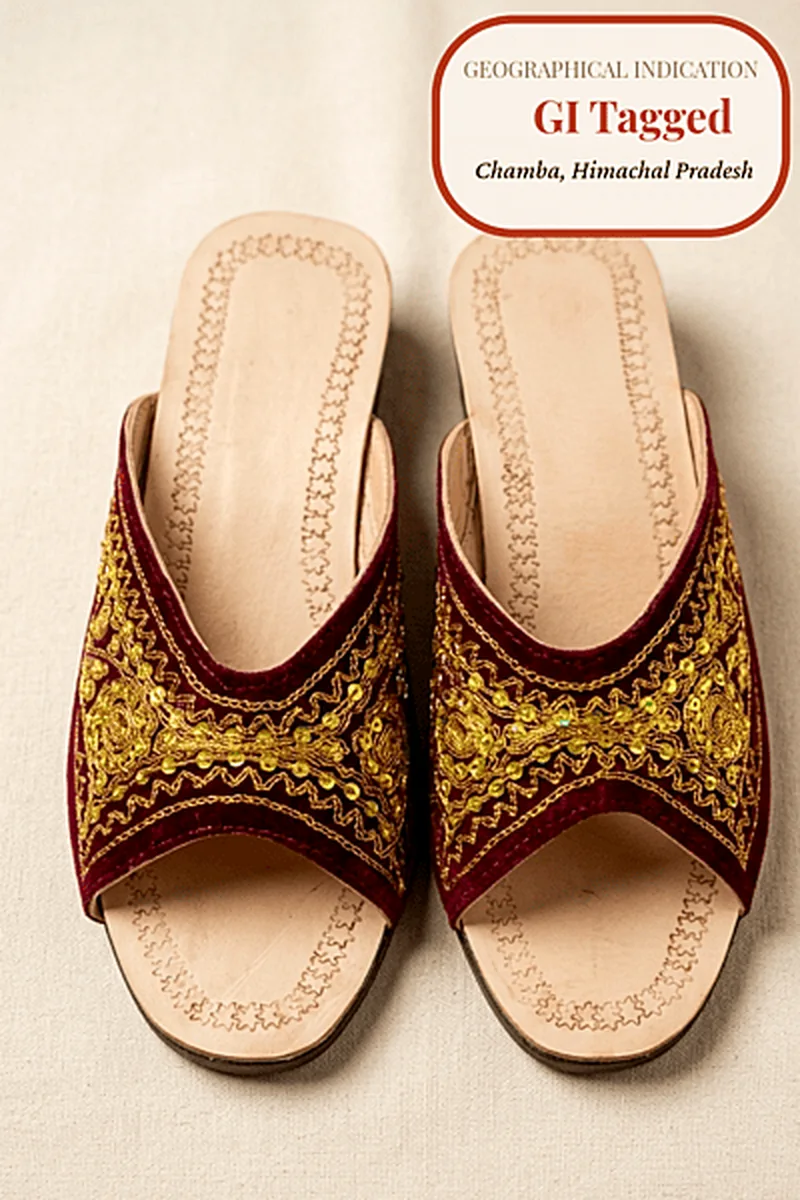
The full embroidery practice — the combined vocabulary of pattern-making, thread-laying, and sequin-setting that defines Chamba Chappal craft — is known locally as Chamba Kadhai.
Sitara is the sequin element: the word itself means "star" in Hindi and Urdu, and each sequin earns that name by catching light the way a star does — from a specific angle, briefly, brilliantly. On a single pair of Chamba Chappals, there may be several hundred Sitara sequins. Each one is placed by hand.
The motifs that appear most frequently draw on the same visual vocabulary as Chamba Rumal — the valley's celebrated embroidered cloth, which is also GI-tagged. The mango leaf is especially traditional. Scrolling florals, botanical forms — the particular elegance of a craft that developed in a court that cared deeply about beauty.
"A skilled artisan takes several days to complete a single pair. No two pairs are identical."
The construction — velvet mounted on leather backing for embroidery stability, wooden heel dressed in the same matching velvet, leather insole and lining — is a complete design object. Every element is considered. Nothing is accidental.
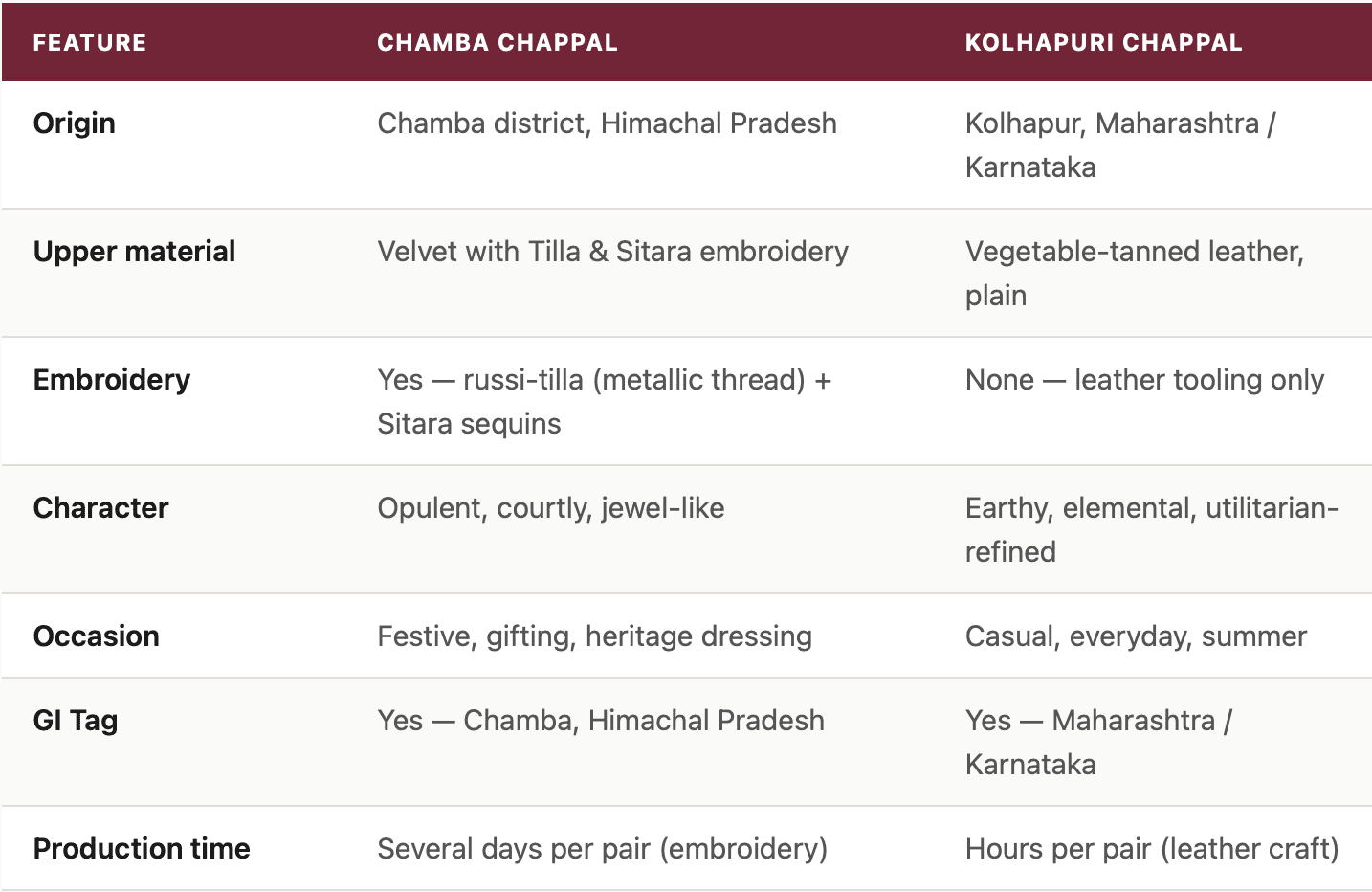
Chamba Chappal vs. Kolhapuri — What Is the Difference?
Indian heritage footwear has a rich vocabulary, and the comparison people reach for most often is the Kolhapuri. Both are GI-tagged. Both are handcrafted. Both are deeply rooted in specific Indian geographies. The differences are significant.
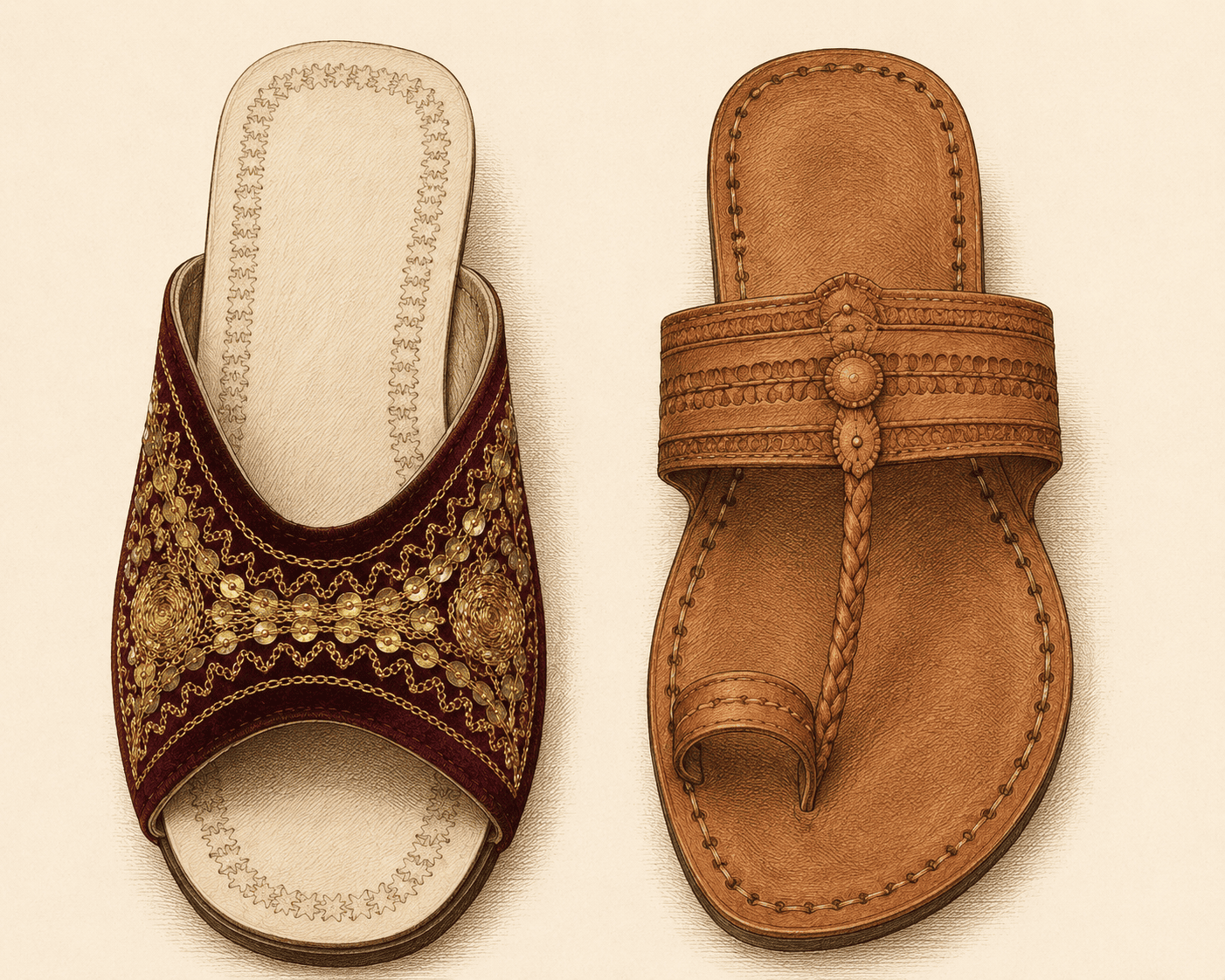
They are both Indian. Both heritage. Both worth owning. They are not the same thing.
In 2025, Prada's Spring-Summer 2026 collection featured sandals closely resembling Kolhapuri chappals — described simply as "leather sandals," with no acknowledgement of their Indian origins. The backlash was immediate: artisan communities protested, a public interest litigation was filed in the Bombay High Court, and the controversy was covered globally. Prada subsequently acknowledged the Indian inspiration and entered collaboration talks with Kolhapuri artisans — a landmark moment that signalled how seriously the world is now being forced to reckon with GI-tagged Indian craft. That conversation has permanently elevated the question of knowing where your craft comes from and who made it.
The GI Tag — What It Means and Why It Matters
The Geographical Indication tag granted to the Chamba Chappal under India's Geographical Indications of Goods (Registration and Protection) Act, 1999 is not a marketing label. It is a legal protection.
Under this registration, only footwear produced in the Chamba district — by artisans using the traditional methods of the craft — can legally be called a "Chamba Chappal." Producers outside Chamba who use the name face criminal penalties under the Geographical Indications of Goods (Registration and Protection) Act, 1999. The GI tag documents the craft's geography, its techniques, and its production standards. It is the craft's legal identity.
Himachal Pradesh has eleven GI tags to its name. Among them: the Kullu Shawl, Kangra Tea, Chamba Rumal, Kinnauri Shawl, and Kangra Painting. The Chamba Chappal is the newest addition to this list — recognized precisely because its craft traditions are both distinctive and rigorously documented.
How to Identify an Authentic Chamba Chappal
Not everything sold as a Chamba Chappal is one. Here is what to look for.
- The embroidery is hand-worked, not machine-made. Look for slight dimensional variation in the russi-tilla thread — it will sit fractionally above the velvet surface. Machine embroidery lies flat, uniform, and without texture. The difference is visible under any decent light.
- The construction is leather throughout. Sole, insole, and lining. The velvet upper will have a leather backing — this is what keeps the embroidery firm and stable over time. A rubber base beneath the leather sole is a thoughtful contemporary adaptation for grip; it does not compromise the craft above it.
- The motifs are botanical. Mango leaves and scrolling florals are the most traditional forms. Geometric or abstract patterns are not historically characteristic of Chamba Chappal.
- The seller can tell you where it was made. An authentic seller can name the district. The best sellers can name the artisan. If a seller cannot tell you either, that absence of information is itself information.
- The price reflects the labour. Genuine hand-embroidered Chamba Chappals take days to complete. They are not ₹300 footwear. If the price seems too low, ask why — and if there is no good answer, walk away.
Frequently Asked Questions
The cobbler the Katoch princess brought to Chamba in 1808 did not know he was founding a craft lineage. He was solving an immediate problem - shoes that did not match the court she had arrived in.
Two centuries later, the craft he started carries a government protection, a GI tag, a vocabulary of motifs that has survived kingdoms, migrations, and the long, relentless pressure of mass production.
When you carry a Chamba Chappal home, you carry all of that. A geography, a royal court, a cobbler's pride, two centuries of artisan memory, and the particular quality of light that catches on russi-tilla thread at dusk
Editorial Note:This article was researched and written with AI assistance, under the editorial guidance and curation of the Yatrika team. All historical claims, craft documentation, and legal references have been independently verified against primary sources before publication.